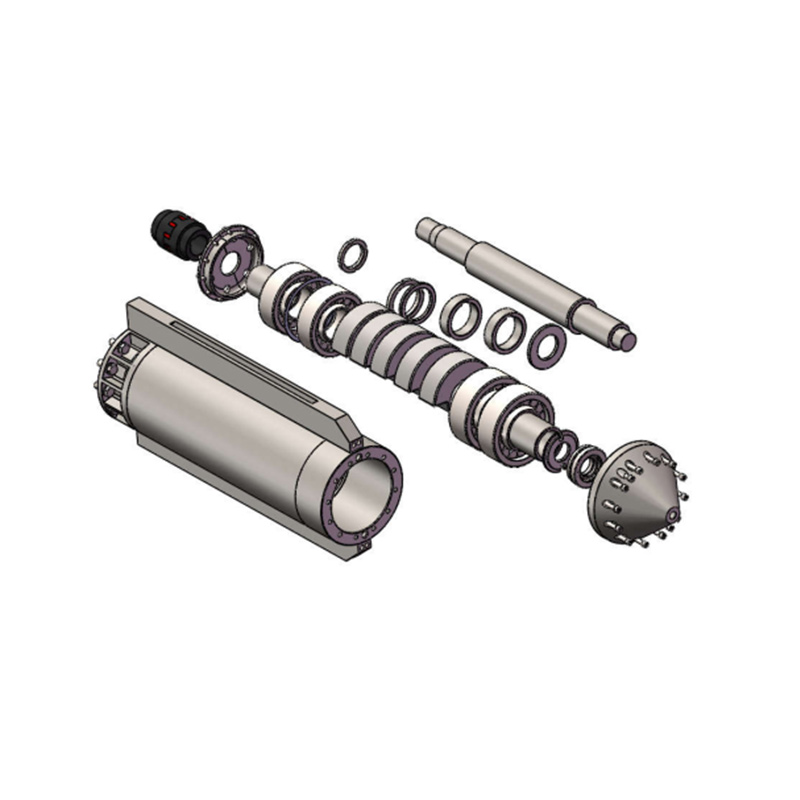
Ground improvement project margins and timelines depend heavily on equipment efficiency. Matching vibro compaction tools to geotechnical realities determines whether you finish on schedule or face massive delays. Selecting the incorrect vibroflot diameter leads to immediate site failures. Under-sizing results in unmet bearing capacity and forces closer grid spacing, which drastically increases time and operational expenses. Over-sizing causes equipment refusal, excessive wear on base machines, wasted fuel, and severe aggregate supply bottlenecks.
To achieve target compaction and build reliable stone columns, project engineers must evaluate the specific operational thresholds of the 377mm and 426mm models. This guide breaks down the technical trade-offs between these two standard sizes based on soil strata, power requirements, flushing dynamics, and logistical constraints. Understanding these variables ensures you align the equipment perfectly with site conditions, base machine capabilities, and project deadlines.
Geotechnical Match: The 377mm unit is highly efficient for standard stone columns in moderately compressible soils, while the 426mm unit is engineered for deep penetration and dense granular soils requiring higher amplitude.
Power-to-Size Ratios: Upgrading to a 426mm diameter introduces variable power options (e.g., 100kW vs 130kW), which must be matched to the required centrifugal force and depth.
Logistical & Aggregate Impact: Larger diameters require exponentially higher crane lifting capacities and a much faster on-site aggregate supply chain to prevent operational bottlenecks.
Supplier Vetting: Sourcing from a reputable top feed vibroflot supplier ensures accurate performance data (amplitude, frequency, eccentric moment) rather than inflated marketing specifications.
Why Vibroflot Diameter Dictates Project Success
The diameter of your compaction equipment directly dictates the radial zone of influence during penetration. This radial zone represents the horizontal distance from the center of the probe where the soil achieves the required relative density. A larger zone of influence allows engineers to design a wider grid spacing for stone columns. Expanding the grid spacing reduces the total number of penetration points required across the site. Fewer points directly compress the overall project timeline and cut labor hours.
The physics of vibro compaction rely entirely on the internal dimensions of the equipment housing. The outer diameter limits the physical size and mass of the eccentric weight housed inside the lower tube. A larger diameter accommodates a heavier eccentric mass. When this mass rotates at high speeds, usually around 1800 RPM, it generates significantly higher centrifugal force and amplitude. This increased energy transfer breaks down the soil matrix, liquefies the surrounding granular material, and forces the soil particles into a denser configuration. Without sufficient diameter to house a heavy eccentric weight, the equipment simply cannot generate the force needed to compact highly resistant soils.
The cross-sectional area also influences the volume of stone backfill placed per lift during top-feed operations. A wider probe creates a larger cavity in the ground. When the operator retracts the equipment slightly and re-drives it, the probe forces a larger volume of aggregate radially outward into the surrounding soil matrix. This creates a stone column with a larger functional diameter, which inherently possesses a higher load-bearing capacity. Project engineers must calculate the exact volume of stone required per linear meter based on the probe size. If you fail to calculate this, your aggregate supply chain will fall behind production.
Flushing dynamics scale directly with the size of the equipment. During penetration, water or air pumps through the tip to break surface tension, cool the internal motor, and flush displaced soil up the annulus. The annulus is the open space between the probe and the borehole wall. A larger probe creates a tighter annulus in dense soils. This requires significantly higher flushing volumes and pump pressures to clear the debris. Failing to match the flushing pump capacity to the equipment diameter leads to hydro-lock. The probe gets stuck in the ground, causing severe project delays and massive stress on the crane boom during extraction attempts.
Equipment Diameter
Eccentric Mass Capacity
Resulting Amplitude
Flushing Pressure Requirement
377mm
Standard
Moderate (8-12mm)
Standard (6-8 Bar)
426mm
Heavy
High (12-16mm)
High (8-12 Bar)
The 377mm Top Feed Vibroflot: Capabilities and Limitations
The 377mm top feed vibroflot serves as the industry workhorse for standard vibro replacement and compaction tasks. Its balanced profile makes it highly adaptable to a wide range of commercial and infrastructure projects. This size offers an excellent blend of penetration capability, maneuverability, and energy efficiency. Contractors default to this size when dealing with typical alluvial deposits or reclaimed land.
This equipment excels in loose to medium-dense sands, silty sands, and gravels. Geotechnical engineers typically specify this size when Standard Penetration Test (SPT) N-values range between 5 and 20. Cone Penetration Test (CPT) tip resistances should indicate moderately compressible strata. In these conditions, the centrifugal force generated by the 377mm unit easily achieves target relative densities. It does this without over-stressing the base machine or burning excess diesel fuel.
The operational advantages of this size are primarily logistical. The lower gross weight of the probe and its extension tubes means standard crawler cranes can handle it safely. You generally only need a crane with a 40- to 50-ton lifting capacity. This compatibility eliminates the need to mobilize heavy-duty, specialized cranes to the site, drastically reducing mobilization costs. Additionally, the smaller cross-section requires lower flushing water volumes. You avoid building massive on-site water reservoirs and high-capacity slurry management systems.
Handling the equipment during top-feed stone column construction is highly manageable for the ground crew. The typical deployment follows a strict sequence:
The crane positions the probe over the designated grid point.
The operator activates the water pumps to initiate flushing at the tip.
The probe penetrates the soil under its own weight and vibration.
Upon reaching design depth, the operator flushes the hole clean.
The loader dumps aggregate at the surface, which falls down the annulus.
The operator lifts and re-drives the probe in 1-meter increments to compact the stone radially.
However, the 377mm unit has strict limitations in the field. It struggles significantly in highly dense strata where SPT N-values exceed 30. The lower penetration weight and restricted maximum centrifugal force mean the probe often reaches refusal before hitting the design depth. Attempting to force the equipment through hardpan layers or dense gravel beds causes the probe to deviate off plumb. This results in angled stone columns that fail load-bearing specifications. Furthermore, in deep compaction projects exceeding 20 meters, the friction along the extension tubes overcomes the vibrational energy, stalling the penetration process entirely.
The 426mm Top Feed Vibroflot: Heavy-Duty Compaction
When geotechnical environments demand maximum energy transfer, the 426mm top feed vibroflot becomes the necessary escalation. This heavy-duty equipment overcomes high tip resistance and delivers massive compaction energy deep into the soil matrix. The larger housing allows for a substantially heavier eccentric mass. This produces the high amplitude required to liquefy highly resistant granular soils that smaller units cannot penetrate.
Project triggers for escalating to this size include deep compaction requirements often exceeding 25 meters. You also need this size when facing highly resistant intermediate soil layers or design specifications that demand exceptionally wide grid spacing. By maximizing the radial compaction zone, contractors reduce the total number of penetration points by up to 30% compared to smaller units. This reduction saves weeks on large-scale land reclamation projects, port developments, and heavy industrial foundations.
Upgrading to this diameter introduces the need to evaluate specific power configurations based on soil density. A 426mm 100kw vibroflot for ground improvement balances the benefits of larger diameter displacement with standard power consumption. This configuration works well for moderately dense soils where you want the wider cavity for stone placement, but you do not need extreme centrifugal force. It allows contractors to build wider stone columns without upgrading their standard 200kVA site generators.
Conversely, the 426mm 130kw top feed vibroflot is a high-power application designed for maximum centrifugal force. The 130kW motor provides the rotational torque necessary to spin a massive eccentric weight even when the probe is buried deep in highly dense strata. This configuration is mandatory when attempting to penetrate dense gravels and overcome high tip resistance. The increased power prevents the motor from stalling under heavy soil confinement. You will need a generator sized at 250kVA to 300kVA minimum to handle the startup surge and continuous draw of this motor.
The production rates associated with these larger units are significantly higher, but they strictly require a robust on-site aggregate supply chain. Because the wider probe displaces more soil, the volume of stone placed per hour increases dramatically. If the site loader cannot deliver aggregate to the borehole fast enough, the equipment sits idle in the ground. Contractors must ensure their stockpiling footprint and loader capacity scale to match the consumption rate of the heavy-duty equipment. A single 426mm unit can easily consume 30 to 40 cubic meters of stone per hour under optimal conditions.
Head-to-Head Technical Evaluation: 377mm vs 426mm
To make an informed decision, project engineers must compare these two sizes across critical performance, logistical, and maintenance metrics. The choice is rarely about which unit is inherently better. It is about which unit aligns perfectly with the site constraints.
Centrifugal force and radial reach are the primary differentiators. The 377mm unit typically generates centrifugal forces in the range of 300 to 400 kN. This achieves an effective compaction radius of 1.5 to 2.0 meters depending on soil conditions. In contrast, the 426mm unit, especially in the 130kW configuration, generates forces exceeding 500 kN. This pushes the effective compaction radius well beyond 2.5 meters. This massive difference in radial reach allows for the expansion of the grid spacing.
Technical Metric
377mm Top Feed Vibroflot
426mm Top Feed Vibroflot
Typical Motor Power
75kW - 100kW
100kW - 130kW
Centrifugal Force
300kN - 400kN
400kN - 550kN
Ideal Soil Density (SPT N-Value)
5 to 20 (Loose to Medium)
15 to 35+ (Medium to Dense)
Minimum Crane Capacity
40 - 50 Tons
70 - 80+ Tons
Generator Requirement
150kVA - 200kVA
250kVA - 300kVA
Base machine compatibility acts as a strict limiting factor in the field. Standard crawler cranes easily handle the 377mm unit. However, the 426mm unit features a heavier probe and larger extension tubes. It also generates massive dynamic loads during extraction from dense soils. This requires a crane with a minimum lifting capacity of 70 to 80 tons. Using an undersized crane risks boom damage or tipping during extraction. Additionally, the electrical power packs must handle the continuous high-amperage draw of the 130kW motor. Using an undersized generator leads to voltage drops, overheating, and eventual motor failure.
Maintenance profiles and wear parts differ significantly between the two sizes. The extreme vibrational forces generated by the 426mm unit place immense stress on the internal bearings, couplings, and vibration isolators. The eccentric mass bearings run at 1800 RPM under extreme load and require specific high-temperature grease. Higher-power units demand rigorous, strictly scheduled preventative maintenance. Bearing life expectancy is generally shorter on the 130kW models due to the extreme operating conditions. You must keep specialized replacement parts and trained mechanics on site. The 377mm unit operates under lower stress and typically offers longer intervals between major overhauls.
When analyzing the cost-to-performance ratio, engineers look at the operational cost per linear meter of stone column. The 377mm unit boasts lower fuel consumption, cheaper mobilization, and less expensive wear parts. However, because it requires a tighter grid spacing, the total linear meters of drilling required for the project is higher. The 426mm unit has a higher hourly operating cost and requires more expensive base machines. Yet, its ability to complete the site with fewer penetration points often results in a lower overall cost per square meter of improved ground on large-scale projects.
Implementation Risks and Mitigation Strategies
Field deployment of ground improvement equipment carries inherent risks. Avoiding costly equipment mismatches requires a clear understanding of how the machinery interacts with the specific geotechnical profile. You must build mitigation strategies into the project planning phase before mobilizing any equipment to the site.
The risk of over-sizing is a common pitfall. Many contractors assume bigger equipment guarantees faster results. Deploying a massive 426mm 130kW unit in shallow, highly resistant strata or very dense shallow gravels causes severe problems. The extreme energy has nowhere to dissipate in shallow hardpan. The vibration travels back up the extension tubes instead of into the soil. This results in severe mast vibration, potential damage to the crane boom, equipment refusal, and premature bearing failure inside the probe. Over-sizing also wastes fuel and overburdens the site logistical footprint unnecessarily.
Conversely, the risk of under-sizing carries severe financial penalties. Using a 377mm unit in deep, dense soils leads to plumb deviation. The lighter probe deflects off hard soil lenses instead of penetrating them. The equipment fails to reach the design depth, and the resulting stone columns lack the required diameter and density. This ultimately leads to failing post-compaction CPT tests. The contractor must then mobilize back to the site to install secondary columns between the primary grid, destroying the project profit margin.
Environmental and vibration constraints dictate equipment selection in urban or brownfield sites. The higher ground-borne vibrations generated by a 426mm 130kW unit travel further through the soil matrix. This easily violates structural proximity limits, causing settlement or structural damage to adjacent buildings, underground utilities, or retaining walls. In these sensitive environments, engineers must step down to a 377mm unit. You utilize a tighter grid spacing to achieve the required density while keeping peak particle velocity (PPV) within safe legal limits.
Procurement realities play a major role in risk mitigation. You must partner with a transparent top feed vibroflot supplier. The market contains equipment with inflated specifications. Buyers must demand verifiable data on motor insulation classes and bearing origin certificates. Ensure the manufacturer uses high-quality brands like SKF or FAG for the eccentric bearings. Demand real-world amplitude measurements taken under load, not just in free-hanging factory tests. A reliable supplier provides Factory Acceptance Test (FAT) reports to validate the true capabilities of the equipment.
Framework for Final Selection
To navigate these variables, project engineers should utilize a structured decision matrix. This framework ensures the final equipment selection relies on empirical data rather than assumptions or fleet availability alone.
Analyze the GBR (Geotechnical Baseline Report): The foundation of equipment selection lies in the soil profile. Map the target depths, soil classifications, and required bearing capacities directly to the vibroflot specifications. Identify the hardest layers the probe must penetrate. Select the diameter and power rating capable of overcoming that specific tip resistance.
Calculate Grid Spacing Economics: Perform a comparative analysis of the total number of compaction points required using a 377mm versus a 426mm unit. Calculate the estimated time per point, including penetration, stone feeding, compaction, and extraction. Multiply this by the total points to determine the true project duration for each size. This calculation reveals whether the faster production of the larger unit offsets its higher mobilization costs.
Assess Fleet Constraints: Audit the existing base machines available for the project. Check the dynamic load charts of the crawler cranes. Ensure they can safely extract the chosen vibroflot diameter from dense soil without tipping or boom damage. Verify that the on-site power generators handle the startup surge and continuous draw of the selected motor. Ensure the water or air pumps deliver the required flushing volume at the correct bar pressure.
Audit Site Logistics: Ensure the physical footprint of the site handles the operations. A high-production 426mm unit requires massive aggregate stockpiles and continuous heavy loader traffic. If the site is congested and aggregate delivery trucks cannot maintain a steady supply, the heavy-duty equipment bottlenecks. This renders its production advantages useless.
Conclusion
Choosing the correct equipment diameter dictates the success of your ground improvement project. The 377mm unit remains the practical choice for standard, mid-depth projects in moderately compressible soils where standard rig availability and maneuverability take priority. The 426mm unit is absolutely essential for deep, dense compaction projects that demand wide grid spacing, high production rates, and maximum energy transfer. Power requirements must be evaluated concurrently with diameter to ensure adequate penetration and compaction energy.
Audit your Geotechnical Baseline Report to map maximum tip resistance against the centrifugal force ratings of both the 377mm and 426mm models.
Calculate the required aggregate delivery rate for your chosen diameter and verify your site loaders can maintain that pace without causing equipment idle time.
Inspect your crawler crane fleet to confirm the dynamic lifting capacity exceeds the extraction load requirements of the larger 426mm unit.
Q: What is the standard vibroflot diameter for stone column construction?
A: The 377mm and 426mm models are the industry standards. You select the 377mm for moderate soils and standard commercial projects. You reserve the 426mm for heavy civil infrastructure, deep compaction, and highly dense granular soils that demand maximum centrifugal force.
Q: How does vibroflot diameter affect compaction radius?
A: The diameter determines the size of the internal eccentric weight. A larger diameter houses a heavier mass, which generates higher centrifugal force when rotated. This higher force transfers more energy into the surrounding soil matrix, significantly expanding the radial zone of influence and allowing for wider grid spacing.
Q: Can a standard crawler crane operate a 426mm top feed vibroflot?
A: Generally, no. While a 40- to 50-ton crane handles a 377mm unit, a 426mm unit requires a crane with a minimum lifting capacity of 70 to 80 tons. This accounts for the heavier gross weight of the equipment and the massive dynamic loads generated during extraction from dense soils.
Q: What is the difference between a 426mm 100kW and a 426mm 130kW vibroflot?
A: Both models share the same physical displacement diameter, creating the same sized cavity for stone placement. However, the 130kW motor provides significantly higher rotational torque and centrifugal force. This prevents the motor from stalling when penetrating highly dense, resistant soil strata.
Q: Do larger vibroflot diameters require more flushing water?
A: Yes. A larger diameter probe creates a tighter annulus in dense soils. To prevent the equipment from getting stuck via hydro-lock, higher volume and higher pressure flushing pumps are required to clear displaced soil and cool the motor effectively.
Q: When should I choose a 377mm top feed vibroflot over a 426mm model?
A: Choose the 377mm unit when working in softer, moderately compressible soils, when limited to smaller base machines, or when operating in urban environments where strict ground-borne vibration limits prevent the use of high-amplitude equipment.
Q: How do I verify the specifications from a top feed vibroflot supplier?
A: Always request comprehensive documentation before procurement. Demand verifiable case studies, bearing origin certificates to ensure high-quality components, and Factory Acceptance Test (FAT) reports that show real-world amplitude and frequency measurements taken under load.